

PERFORMANCE engine power 30 years ago is now the norm for today's average family car, thanks to car makers' ingenuity in meeting environmental legislation challenges.
Analysis by data technology specialists Vehicle Data Global (VDG) reveals that today's average engine power output matches many legendary performance cars of yesteryear.
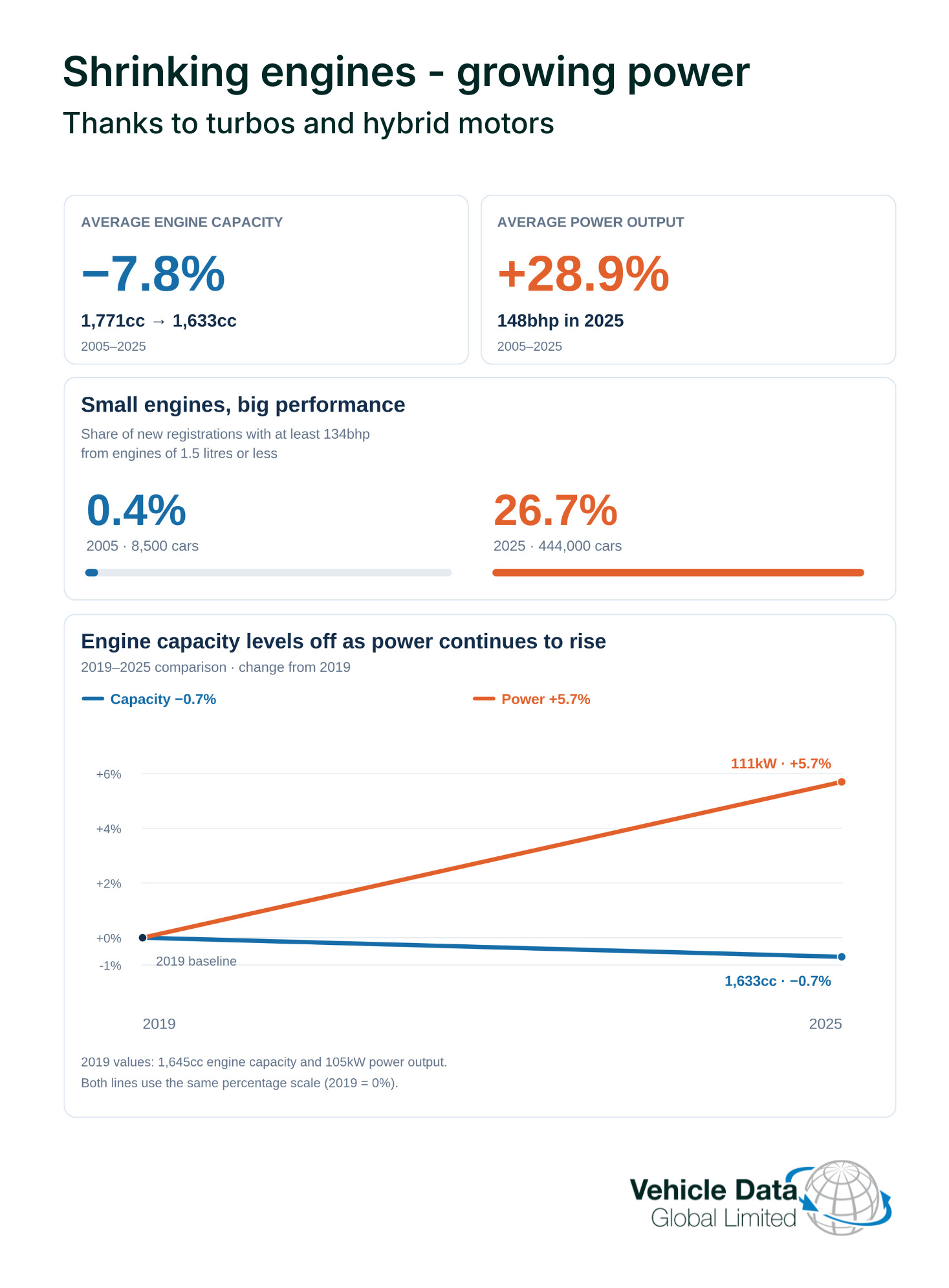
Engineers, under pressure from ever-tighter environmental legislation on emissions, have achieved an average power output today of 148 bhp - a 28.9% increase in power over just 20 years.
Shrinking engines - growing power
Thanks to turbos and hybrid motors
Small engines, big performance
Share of new registrations with at least 134bhp
from engines of 1.5 litres or less
Engine capacity levels off as power continues to rise
2019–2025 comparison · change from 2019
2019 values: 1,645cc engine capacity and 105kW power output.
Both lines use the same percentage scale (2019 = 0%).
It means that an increasingly high proportion of ordinary family cars today match the power output of classic sports cars and hot hatches of the past.
Today's Skoda Octavia 1.5 TSI e-TEC 150PS DSG mild hybrid produces brake horsepower equivalent to the beloved Vauxhall Astra GSi and Renault Clio Williams of the 1990s, despite a 25% smaller engine.
And the Nissan Qashqai 1.3 DIG-T 158PS mild hybrid produces around 156 bhp - more than the 6-cylinder 2.5 litre classic Triumph TR6 PI in the early 70s.
Vehicle Data Global conducted the analysis to illustrate how the engineering ingenuity of turbocharging and hybrid technology squeezed ever more power out of the smaller engines that were necessary to help meet increasingly stringent CO2 target reductions.
They found that since 2005, average engine capacity fell 7.8%, from 1,771cc to 1,633cc, while average power per litre rose by 42.9% to 69.1kW per litre - a measure of power output relative to engine capacity. In the case of hybrid vehicles, reported power figures in VDG's analysis include the contributions from electric motors, rather than reflecting the combustion engine's output alone.
VDG says that the data challenges the automotive enthusiast's long expressed adage that 'there's no replacement for displacement'.
Median engine size today (the middle value among all engine capacities) has fallen over 20 years from 1,599cc to 1,498cc, while median power rose from about 107bhp to 138bhp.
VDG took 134bhp (100kW) as a benchmark for performance, finding that back in 2005 only 8,500 cars producing at least that much power from an engine of 1.5 litres or less were registered, compared with 444,000 last year. That's an increase from 0.4% to 26.7% of all registrations.
Ben Hermer, Operations Director of VDG, said: "Nothing illustrates the engineering success of modern car makers better than our analysis of powertrain output increases from ever-shrinking engines over the past 20 years.
"They did this by an ingenious combination of turbocharging and introducing new contributions, in the form of hybrid technology.
"Back in 2005, getting 134bhp+ from a 1.5-litre-or-smaller engine was unusual, whereas now more than one new registration in four offers that advantage."
The increasing practical appeal of very small engines in general, as they became more efficient, is also highlighted in the analysis.
It shows that even 1.0-litre engines increased from about 3.3% of registrations in 2005 to a peak of 18% in 2020, before settling back last year to 14.5%.
But the downsizing of engines now shows signs of reaching a plateau, with little change in average engine capacity in recent years, even as power outputs continue to rise.
Average capacity was about 1,645cc in 2019 and 1,633cc in 2025, whereas power continued climbing from 105kW to 111kW, suggesting that ever more efficiency is being achieved even as engine capacities are no longer reducing at the same rate as before.
Car makers faced increasingly stringent regulatory pressures as governments focused on reducing emissions and they responded with a combination of engine downsizing, turbocharging and the introduction of electrical motor assistance.
In the process, they radically changed the relationship between engine size and performance. The old intuitive assumption that a 2.0-litre car is inherently more powerful than a 1.5 is no longer true.
Cutting emissions without sacrificing performance was a difficult challenge but they achieved more than that, by achieving major improvements at the same time.
All of this suggests that it might be time to abandon the old adage that there is no replacement for displacement.